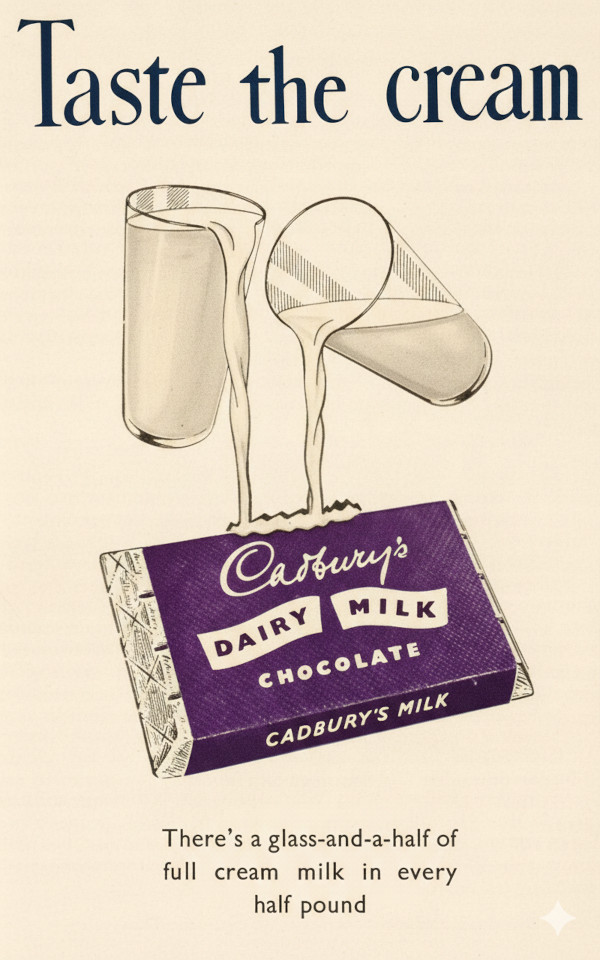
Cadbury Chocolate Advert
The Cadbury family and quaker schools.
Description
The Cadburys, Quaker Schools, and the Gospel of Chocolate
For the Cadbury family, chocolate was more than a business—it was a vehicle for social gospel. As devout Quakers (members of the Religious Society of Friends) in 19th-century Britain, they were barred from attending universities and many professions. This exclusion forged a unique path: they turned to trade and industry, guided by the Quaker testimonies of Simplicity, Truth, Equality, and Social Justice.
Education was paramount. Quakers believed in the "Inner Light" within every person, which needed nurturing through learning. But existing schools often didn't align with Quaker values. The Cadburys, alongside other great Quaker dynasties like the Frys and Rowntrees, became pivotal in creating an alternative: Quaker schools that educated the mind, the spirit, and the social conscience.
John Cadbury, a tea and coffee dealer who started selling cocoa in 1831, laid the foundation. But it was his sons, Richard and George, who, in 1861, transformed the struggling business into an empire. With immense wealth came immense responsibility—a Quaker principle known as "stewardship." They poured their profits back into their workers and society.
Their most famous act was the creation of Bournville in 1879. What began as a factory in the countryside became a revolutionary "model village" for workers, with green spaces, good housing, pensions, and medical care. At the heart of Bournville's ethos was education.
The Cadbury Educational Legacy
The Cadburys didn't just found schools; they infused the very idea of Quaker education with their practical, compassionate ethos:
Bournville's Own Educational Ecosystem: George Cadbury established a network of educational facilities for his workers and their families: from day schools for children to evening classes and libraries for adults, and even an early "works school" for apprentices. Education was a lifelong right.
The Bournville Village Trust and Schools: The Trust, set up to manage the village, was instrumental in founding Bournville Junior School and other local schools, ensuring the community they built was anchored in learning.
Support for Established Quaker Schools: The Cadbury fortune provided critical financial support to historic Quaker institutions like Sibford School, The Mount School in York, and Bootham School (York). Their donations helped scholarships, buildings, and endowments, ensuring these schools thrived.
A Curriculum for Life: The education they championed went beyond the classical. It included gardening, domestic science, and practical skills—reflecting the Quaker (and Cadbury) belief in the dignity of all work and the importance of a wholesome, balanced life.
For the Cadburys, these schools were factories of character, producing not just scholars but "Citizens of the World" who would carry Quaker values into society.
What Happened to the Cadbury Name in the End?
The fate of the Cadbury name is a story of 20th-century corporate consolidation, marking the end of a unique era of paternalistic, faith-driven capitalism.
The Family Legacy Wanes: By the mid-20th century, the direct family involvement in day-to-day management diminished. The company became a public entity, though it tried to hold onto its Quaker-inspired principles through the Cadbury Trusts, which continued philanthropic work.
The Kraft Takeover (2010): This was the decisive, and for many, heartbreaking, moment. After a hostile acquisition battle, the American food conglomerate Kraft Foods purchased Cadbury for £11.5 billion. Public and political outcry in the UK was immense. It was seen not just as a corporate takeover, but as the end of an iconic British institution with a soul.
The Name Lives On, But the Soul is Altered: The "Cadbury" name remains powerful and is still used on products worldwide. It is now a flagship brand of Mondelez International, the snack-food spin-off from Kraft. While the Bournville factory still operates and some traditions are maintained, the fundamental driver is no longer Quaker stewardship but shareholder profit. The promise made during the takeover to keep a key factory open was broken shortly after.
Conclusion: A Lasting Imprint
So, while the Cadbury company was swallowed by a global corporation, the Cadbury legacy is indelible. Their name lives most meaningfully not on Dairy Milk wrappers, but in the bricks and mortar of schools, the green spaces of Bournville, and in the ethos of Quaker education.
The Cadburys demonstrated that commerce, when guided by profound ethical conviction, could be a force for monumental social good. Their story is a cornerstone of the history of Quaker schools—a reminder that the values on your Sibford School badge, "Trouthe and honour, fredom and curteisye," were once the very principles that built a chocolate empire and, with its profits, nurtured the minds of generations. The family's name may have faded from the boardroom, but its imprint on education and social welfare remains a powerful testament to their faith.
Details
| Year Taken: | 1958 |
| Views: | 34 |
| Uploaded: | February 10, 2026 |